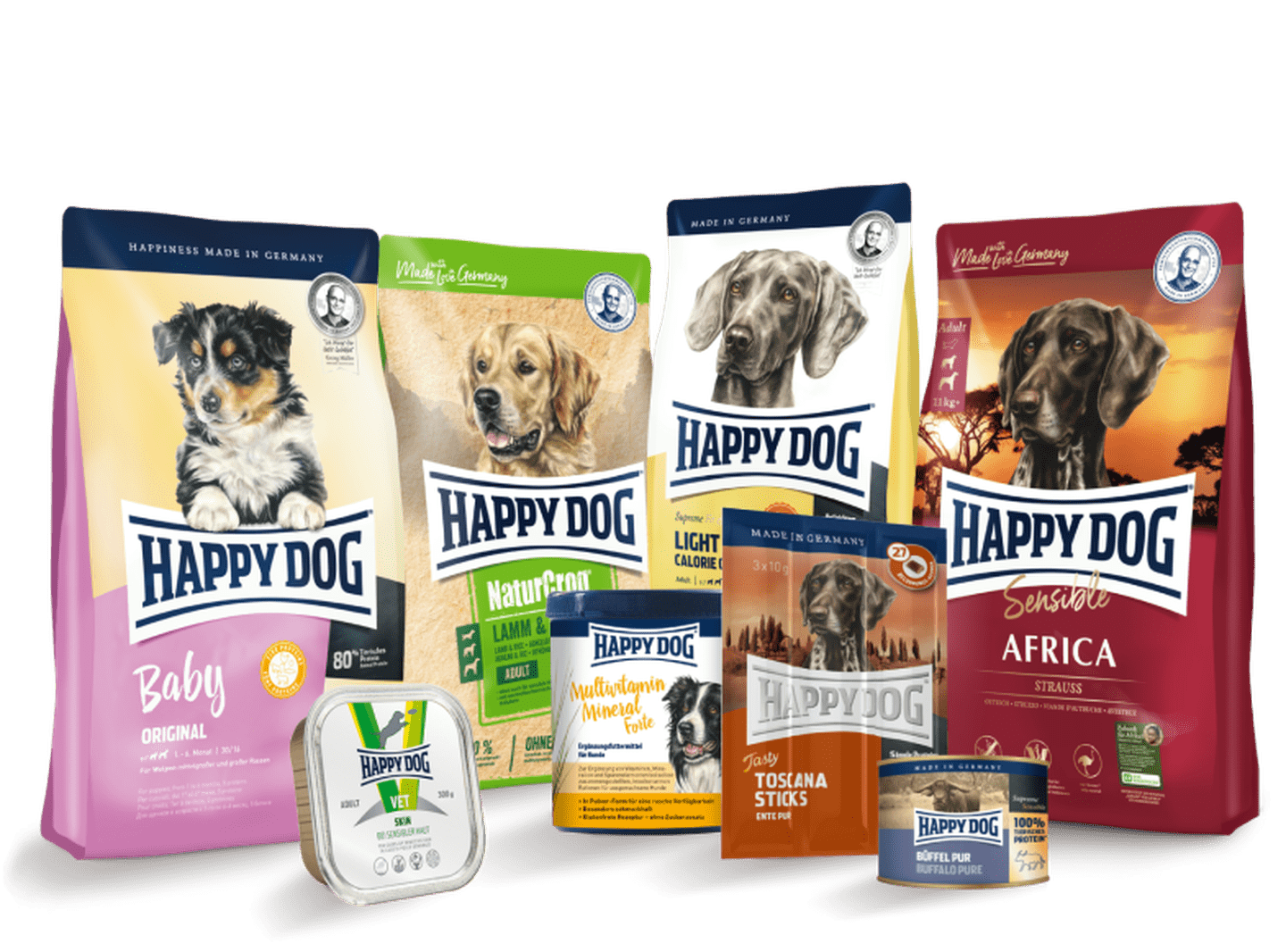



Of course, only the best for your four-legged friend with the Happy Dog Natural Life Concept®
What makes happy dog unique?
Our nutritional concept
The recipe for success of our premium dog food is based on 3 pillars
Natural Ingredients
Only the highest quality ingredients are used to form the basis of our species-appropriate and balance recipes.
Perfect Recipes
Our recipes will always meet the needs and demands of your dog.
Gently prepared
We don't use artificial preservatives or colourings and are inspected by an independent body.
We have been using this philosophy to create our Happy Dog products in Bavaria, for over 50 years. But what is actually in our products?
The right portion of meat
Meat and valuable animal proteins of the best quality are the most important components of our pet food because of their essential amino acids. In the Happy Dog dry food, the proportion of animal protein is included in the total protein
up to 90%
We take nature as a model
The Happy Dog Natural Life Concept® offers your dog a nutritionally sensible combination of all vital substances with natural ingredients. In this way, metabolism and the entire organism are optimally and species-appropriately supported - nutritionally proven based on the example of nature.
In addition to the meat being the main ingredient, and depending on which variety, different carbohydrate sources, Happy Dog dry food contains natural components such as herbs, linseed or seaweed. In order to support the metabolism optimally and in a species-appropriate manner, natural products with health-promoting properties are irreplaceable.
Your dog is provided with everything from which the organism benefits holistically - from a strong immune system to a healthy coat!
Of course, we select the healthy ingredients from nature for our premium dog food specifically according to whether they have positive effects on the health of your loved on and combine these to create an optimal mix of nutrients . So you can be sure that your dog is neither over nor undersupplied and that there are no deficiency symptoms.
The Happy Dog nutritional concept & it's health-promoting properties
Selected Herbs
Natural helpers for the organism - good for the stomach, intestines, circulation and respiratory tract
Ginger
To strengthen the immune system and the musculoskeletal system
Green-lipped New Zealand mussel
Rich in glycosaminoglycans to support the joints and synovial fluid and therefore good for the musculoskeletal system
Yeast (extracted)
Mannanoligosaccharides (MOS) and nucleotides from yeast cell walls are good for a strong immune system (nucleotides help regenerate DNA)
Apple
Dietary fiber containing pectin ensures regular digestion and a stable intestinal flora
Seaweed
Natural supplier of a wide range of essential nutrients, such as minerals and amino acids - for more well-being and a shiny coat
Flaxseed & Sunflower Oil
Rich in essential omega-3 and omega-6 fatty acids for a regular digestion and a shiny coat
Yeast (dried)
To support a stable intestinal flora
Well looked after all round
Vitamins, minerals and trace elements as well as fat, protein, raw fiber and carbohydrates are vital for our pets. Our balanced and diverse pet food ensures an adequate supply of these substances and is supplemented by a variety of healthy ingredients from nature.
We take nature as a model and refine our dog food recipes with healthy herbs from the region. For every Happy Dog food you will find precise information on the composition on the packaging or on our website, which will tell you which ingredients are contained in the respective food. Depending on which health aspect you want to support, you can choose your food according to this.
Example from one of our foods:
The Happy Dog Adult Medium from the Fit & Vital range has the following composition:
Composition
Animal proteins * (14% poultry, 4% lamb), maize, maize flour, rice flour, barley, fish meal (5%, of which 50% salmon flour), poultry fat, hemoglobin *, liver hydrolysate, sunflower oil, beet molasses escalope * (de-sugared), apple pomace *, Potassium chloride, rapeseed oil, yeast *, sodium chloride, seaweed *, flaxseed (0.16%), dried whole egg (0.12%), mussel meat * (0.02%), yeast * (extracted), milk thistle, artichoke, dandelion, ginger (0.013%), birch leaves, nettle, chamomile, coriander, rosemary, sage, liquorice root, thyme, (total dry herbs: 0.16%) *). Metabolizable energy: 1550 KJ / 100g; 3710 Kcal / kg
The linseed it contains is rich in omega-3 and omega-6 fatty acids and has a high content of lecithin and vitamin E. This can have a positive effect on the skin and coat and has an antioxidant effect. In addition, the mussel meat of the green-lipped mussel is rich in glycosaminoglycans and therefore good for the joints and the ginger it contains supports the immune system.
With our healthy whole foods, your four-legged friend is well looked after. Depending on what special requirements your dog has, you can select the right food from our range. If you are unsure about choosing the right feed, our nutrition experts will be happy to provide you with feed advice.
Conclusion
A good dog food today has to be able to do a lot more than just fill you up! Therefore, the balanced dog food from Happy Dog contains natural herbs in addition to the animal proteins that are essential for the dog and the important fiber. So your darling will stay fit and healthy for a lifetime!
Browse our best sellers
The right dog food for every requirement. Get to know our range of balanced and healthy dog food. Why not browse our best sellers and see if you can find your perfect bowl.
